Pricing the Unthinkable: How Political Risk Is Rewriting the Economics of Emerging Market Investment
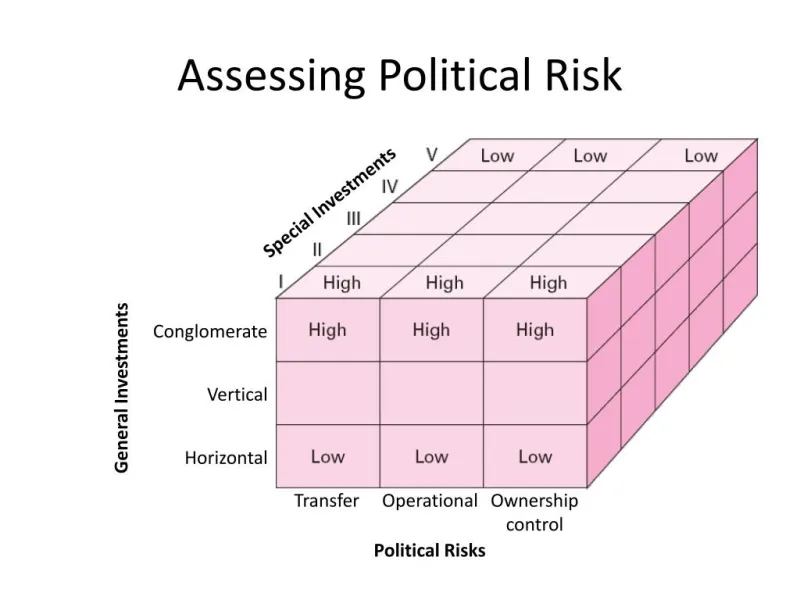
Photo: political risk emerging market investment boardroom strategy, via image1.slideserve.com
For decades, American multinationals treated political risk as a qualitative footnote — something to acknowledge in a board presentation before moving on to the financial model. That era is ending. The convergence of democratic backsliding across multiple regions, accelerating electoral volatility, and the weaponization of regulatory frameworks by governments under political stress has transformed political risk from a soft consideration into a hard line item.
The market for political risk insurance has responded accordingly. The Berne Union, which tracks global export credit and investment insurance, reported that political risk claim volumes have climbed steadily since 2016, with a particularly sharp acceleration following the disruptions of 2020 and 2021. Premiums have risen. Coverage terms have tightened. And the very existence of that tightening is sending a signal that corporate strategists can no longer afford to ignore.
What the Insurance Market Is Actually Telling You
Political risk insurance — offered by institutions such as the Overseas Private Investment Corporation's successor, the U.S. International Development Finance Corporation, as well as private underwriters like AIG, Zurich, and Lloyd's syndicates — covers a range of exposures: expropriation, currency inconvertibility, political violence, and contract frustration by a host government. When underwriters raise premiums or narrow the scope of coverage for a particular country, they are effectively publishing a risk assessment that no analyst report will state quite so plainly.
Over the past three years, insurers have materially increased pricing for coverage in markets including parts of Sub-Saharan Africa, Southeast Asia, and Latin America — regions where electoral outcomes have become less predictable and where incoming administrations have demonstrated willingness to revisit or repudiate agreements signed by their predecessors. In several cases, coverage for certain asset classes has become difficult to obtain at any price.
For corporate strategists, this creates both a warning mechanism and a practical problem. If the cost of insuring a ten-year infrastructure concession in a given market has risen by 40 percent in two years, the internal rate of return on that project has changed — even if nothing else in the financial model has.
Case Geometry: When Deals Collapse Under Political Weight
The pattern is consistent enough to be instructive. Consider the experience of American energy companies that held production-sharing agreements in West African markets during periods of military-influenced political transition. In several documented instances, new governments — sometimes operating under the cover of renegotiation, sometimes through outright regulatory reinterpretation — altered the fiscal terms of agreements that had been structured and priced under prior administrations. The legal recourse available was limited; international arbitration is slow, expensive, and ultimately dependent on the willingness of a sovereign to comply with an adverse ruling.
In Latin America, the pattern has repeated across sectors. Infrastructure investors in markets that experienced sharp left-populist electoral shifts found that the concession economics they had modeled became politically untenable for incoming governments facing domestic pressure on utility pricing and foreign ownership. Some deals were formally renegotiated; others entered a prolonged limbo that produced the same economic outcome without requiring the government to formally breach a contract.
The M&A market has absorbed these lessons, if unevenly. Sophisticated acquirers are now applying what practitioners informally call a "democracy premium" — a discount applied to target valuations in markets where institutional stability is judged to be fragile. The discount reflects not merely the probability of an adverse political event but the cost of the optionality required to manage around one: higher insurance premiums, more complex deal structures, increased legal reserves, and the management bandwidth consumed by operating in a contested regulatory environment.
Frameworks for Quantifying What Resists Quantification
The challenge for corporate finance teams is that political risk does not arrive in a format that plugs neatly into a discounted cash flow model. Several analytical frameworks have emerged to address this structural problem.
Scenario-weighted valuation assigns probability weights to a defined set of political outcomes — continuity, moderate deterioration, and severe disruption — and models the cash flow implications of each before weighting them into a composite valuation. The discipline of building this model forces management teams to articulate assumptions they would otherwise leave implicit.
Political risk scoring systems, offered by providers including Oxford Analytica, Control Risks, and the Economist Intelligence Unit, translate qualitative country assessments into numerical scores that can be applied as discount rate adjustments or as inputs into Monte Carlo simulations. These tools are imperfect, but they provide a defensible methodology for transactions where deal committees require documented risk analysis.
Contract architecture itself has become a risk management tool. Stabilization clauses — provisions that freeze the regulatory and fiscal terms applicable to a project for a defined period — have become standard requests in long-term concession negotiations, though their enforceability varies significantly by jurisdiction. Escrow structures, third-party arbitration provisions under internationally recognized rules, and phased capital deployment tied to milestone-based political assessments are all mechanisms that sophisticated deal teams are now deploying as standard practice rather than as exceptional precautions.
The Strategic Reframe
Perhaps the most important shift in how American companies are approaching this problem is conceptual rather than technical. Political risk is no longer being treated as an external variable that affects an otherwise sound investment thesis. It is being treated as a structural feature of the asset itself — one that must be priced, hedged, and actively managed from day one.
This reframe has implications for how deals are staffed, how investment committees are constituted, and how ongoing monitoring is resourced. Companies that have integrated political risk analysis into their standard deal process — rather than commissioning a one-time country assessment at the point of transaction — are better positioned to detect deterioration early and to exercise structural protections before they become necessary.
The democracy premium is real, it is measurable, and it is rising. The companies that treat it as a core input to their investment calculus will make better decisions in emerging markets. Those that continue to treat it as a qualitative caveat will continue to be surprised by outcomes that, in retrospect, the market had already priced.